Role Management
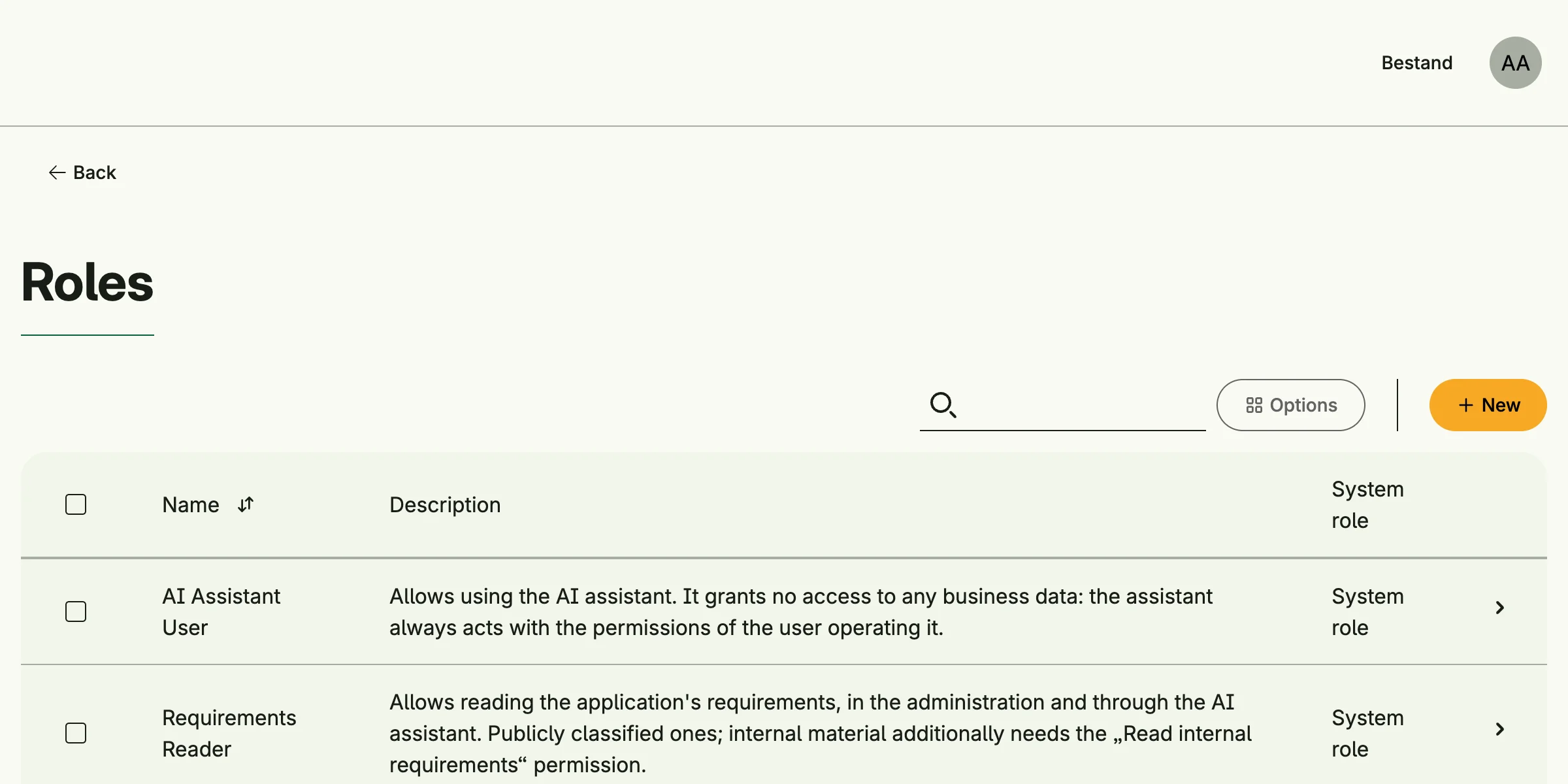
Role Management creates and maintains roles. A role bundles permissions; users which are members of a role get all of its permissions. Role memberships are managed in User Management.
Enable
roles := std.Must(cfg.RoleManagement()) // application.RoleManagementRole Management is always enabled, because User Management depends on it. It has the fields
UseCases role.UseCases and Pages uirole.Pages with the paths Roles and Role.
System roles
Declare roles which your application needs with DeclareSystemRole:
err := cfg.DeclareSystemRole(role.Role{
	ID:          "my.app.librarian",
	Name:        "Librarian",
	Description: "Manages the book inventory.",
}, PermCreateBook, PermDeleteBook)
The call is idempotent and needs a stable ID. Name and description are only written when the role is created, afterwards they belong to the operator. The permissions are a minimum: permissions which an administrator adds are kept. A system role cannot be deleted and its permissions cannot be replaced in the UI, but users can be assigned to it as usual.
Use cases
| Use case | Description |
|---|---|
FindByID | Loads a role. |
FindAll | Lists all roles. |
Create | Creates a role. |
Update | Updates a role, the system flag cannot be changed. |
Upsert | Creates or updates a role by its ID. |
Delete | Deletes a role, system roles are refused. |
FindMyRoles | Lists the roles the subject is a member of. |
ListPermissions | Lists the permissions of a role. |
UpdatePermissions | Replaces the permissions of a role, refused for system roles. |
UpsertPermissions | Adds permissions to a role and never removes any. |
The events role.Updated and role.Deleted are published.
Permissions
| Permission | Allows to |
|---|---|
nago.role.find_by_id | view a role |
nago.role.find_all | list all roles |
nago.role.create | create roles |
nago.role.update | update roles |
nago.role.delete | delete roles |
UI
admin/iam/roles lists the roles, admin/iam/roles/role?role=<id> edits a role and its permissions. The
admin center shows the card Rollen in the group Nutzerverwaltung.
Related
- Tutorial: AI assistant declares a system role.
- The user settings
DefaultRoles,AnonRolesandDefaultSSORolesassign roles automatically, see User Management.